
Mageia 10 Is Here: The Mandriva Successor Keeps Going
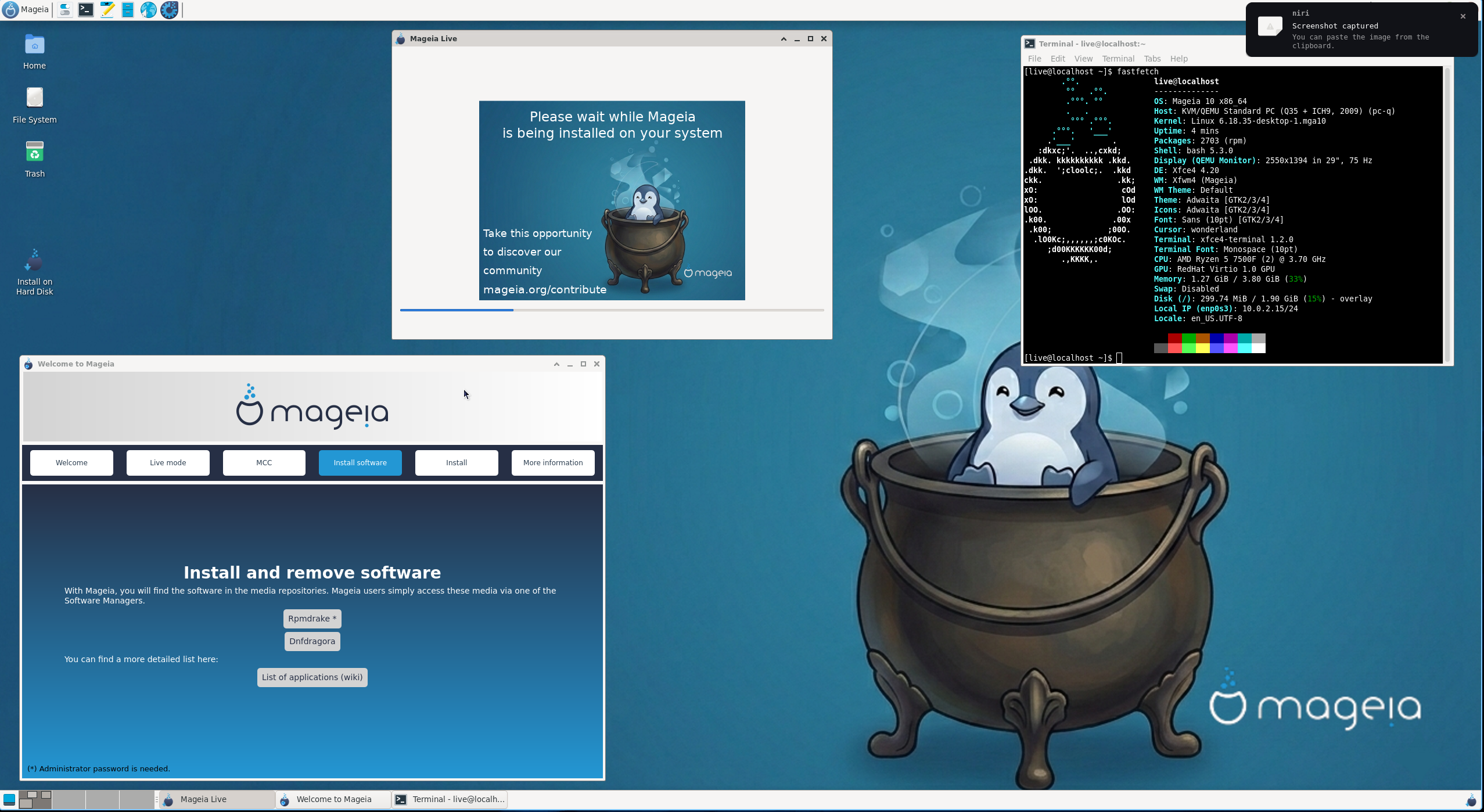
Mageia 10 has been released. The distribution traces its roots back to Mandriva Linux, which ran into financial difficulties in 2010. Since then, an active community has continued developing the project without corporate backing, focusing on providing a reliable desktop Linux distribution.
What's New?
The desktop environments have received significant updates. KDE Plasma 6.5.5 now uses Wayland by default, while GNOME 49, Xfce, and LXQt remain available for users with different preferences. Linux kernel 6.18 LTS and Mesa 26.0 improve support for modern hardware.
Package management has also been modernized. Alongside the traditional urpmi, Mageia 10 now ships with DNF 5, powered by the new RPM 4.20 backend for improved performance. Updated drivers and system components also improve support for Wi-Fi and Bluetooth hardware.
Technical Details
One notable change is that 32-bit installation images now require SSE2-capable processors (i686 instead of i586). As a result, very old systems are no longer supported. Overall, 32-bit support continues to shrink as more upstream projects discontinue 32-bit builds.
The new wallpapers and screensavers use the JPEG XL (JXL) image format at a resolution of 3840 × 2160 pixels, making them suitable for 4K displays. Compared to traditional JPEG images, JXL provides higher image quality at similar file sizes.
Who Is It For?
Mageia has never tried to compete directly with Ubuntu or Fedora. Instead, it targets users looking for a stable and predictable Linux distribution that avoids disruptive changes every few months while offering a mature installer and administration tools. The Mageia Control Center (MCC) remains one of the most comprehensive graphical configuration utilities available on Linux.
Download
Installation and Live ISO images are available from mageia.org. For a complete overview of the changes in Mageia 10, see the official release notes.