
Google Search is Dying! The End of the Free Web?
Note: This article was automatically translated from German to English.
Google Search is Dying! The End of the Free Web?
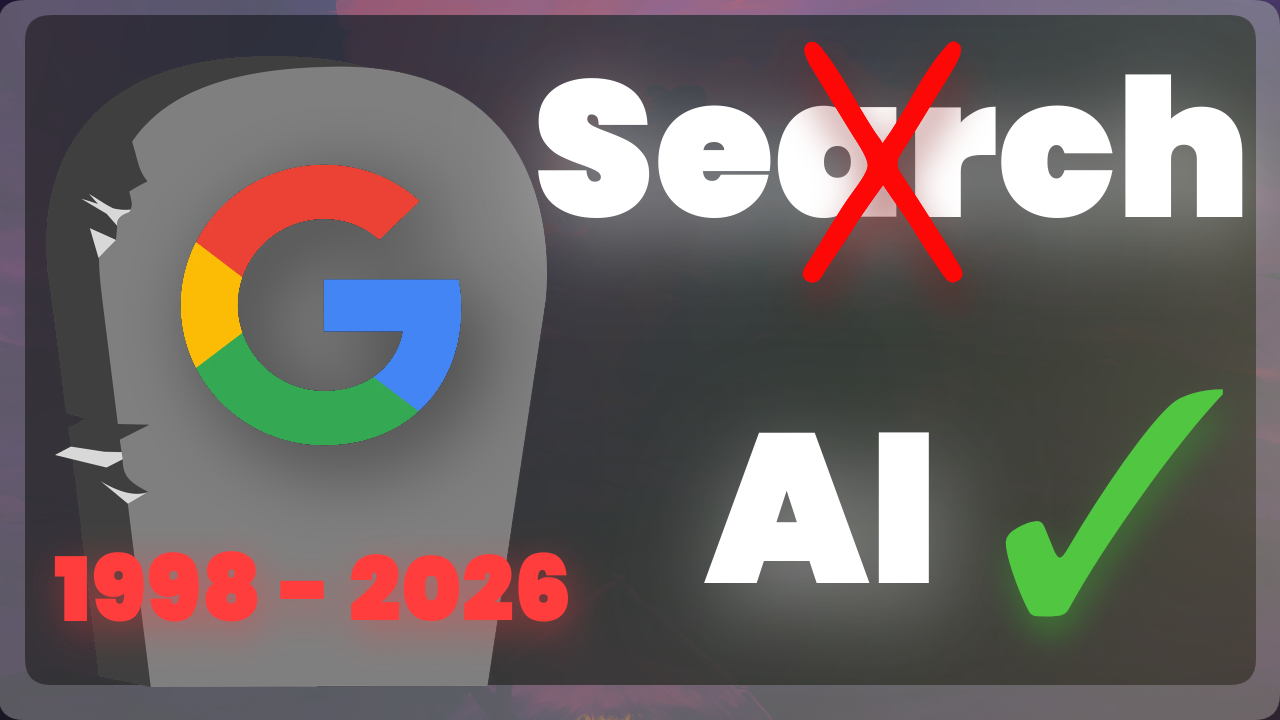
Google is ending search as we know it. At this year's Google I/O 2026 developer conference, the search giant presented a vision that heralds the end of an era: The classic search result with links to other pages is being replaced by default with an AI search. For consumers, this may mean convenience. For the entire ecosystem of the free, open web, however, it is an existential threat.
The "New Era" of Search
Google is facing the biggest transformation in its company's history. For 25 years, we've known Google as a list of ten blue links that take us to other websites. But this principle could soon be history.
Search queries will no longer be entered solely through a narrow keyword bar, but through a multimodal input field that accepts text, images, videos, and even entire Chrome tabs. Instead of directing users to other sites, Google has different plans: As search results, users receive AI-generated summaries directly on the Google interface, without having to visit the actual sources.
The Click Becomes Rare
At first glance, this sounds like convenience. On second glance, it's a competition of displacement. The AI-generated summaries prevent users from clicking on external sites. This means no clicks for the actual sources either.
Data from Pew Research shows that with an AI summary, only 8 percent of users click on a search result. With a normal search, it's 15 percent. Links in AI summaries are clicked in less than 1 percent of cases.
Small publishers are particularly affected. According to a report by Axios, small publishers lost up to 60 percent of their Google traffic year-over-year. This means fewer visitors, less advertising revenue, and fewer viable independent websites.
The Web Becomes a Raw Material Depot
Net critics like Jürgen Geuter hit the nail on the head: Google is declaring "war on the rest of the web". The free web, once characterized by hyperlinks leading from one page to the next, is becoming a mere raw material mine for Google's AI models.
Publishers and creators produce the content used to train Google's AI models like Gemini 3.5 Flash. Google then synthesizes its AI answers precisely from this content. Yet they sit at the end of the value chain. While Google centralizes attention and, above all, advertising revenue on its own interface, content producers are left with only the crumbs that the tech giant drops.
The End of Independence?
Google is building a closed ecosystem. Those who want to use agentic booking functions or certain personalized dashboards have to dig deep into their pockets, exclusively for subscribers of "Google AI Pro" and "Ultra". The open web is being replaced by a controlled, ad-financed interface.
Google argues that the classic search with blue links will remain. But that falls short: User habits change. Once AI is more convenient and faster, no one will return to manual searching.
The Consequences of AI Search
The latest developments in Google Search are technically impressive, but socially dangerous. The decision to transform search from a link list into an answer machine undermines the economic foundation of the free web.
When content producers – bloggers, journalists, small merchants, independent creators – no longer receive visitors, they can no longer fund their sites. Diversity on the net dies out. What remains is a centralized, AI-controlled monotony where only the big players have a voice.
There's another problem: TechRepublic reports that even now, around ten percent of cases deliver incorrect or misleading answers. Less human-created content also means worse AI answers in the long run. A vicious cycle.
AI systems depend on freely available human content. When independent websites disappear economically, the models ultimately lose the very knowledge base they currently benefit from.
Google Laments What It Itself Accelerates
It's an almost tragic contradiction. In September 2025, just months before the big AI offensive at I/O 2026, Google argued in court that "the open web is already in rapid decline." The Stuttgarter Nachrichten picked up on this explosive statement and asked rightly: Why does the market leader itself speak of the end of the free internet? The answer is sobering. By claiming the open web is already in retreat, Google creates the argumentative foundation for its own "rescue" of the same through AI. In truth, the new agentic search is not a lifeline for the free web, but a sprint towards a new dependency. Google acts as if it has to replace a dying system, while simultaneously helping to economically hollow out that very system.
Alternative Search Engines Without AI
The majority of search engines on the market are working on models similar to Google's. For those who want to avoid this development, there are still alternatives:
- DuckDuckGo offers a version of its search engine without AI at noai.duckduckgo.com
- Metager completely avoids AI
- Self-hosted metasearch engines like SearXNG or 4get can be a solution
At search.linuxnation.social, I also provide my own 4get instance for free.
Conclusion
Google is outrunning regulation. While courts debate monopolies, Google is simply changing the product. The free web as we know it is in danger if it only serves as fodder for Google's next AI answer.
The good news: We have a choice. We can switch to alternative search engines, directly support small publishers, and realize that every "zero-click" result is a piece in the mosaic of the open web's demise.
The free web deserves a chance. The open web only survives if people actively use it. The biggest danger of AI search is not that Google provides answers. It's that at some point, no one will produce the original content anymore.